
Goal Tracker vs Habit Tracker: Which One Do You Need?
Habit trackers never worked for my resolutions. What finally did was a spreadsheet: each goal broken into smaller steps, plus a few notes through the year on how it was going. Steps and reflection did more for me than any streak ever did, and that's the app I eventually built.
The confusion is understandable, because the two kinds of app look alike and plenty of apps claim to be both. But they answer different questions. A habit tracker asks "did you do it today?" A goal tracker asks "how close are you to done?"
Full disclosure: I make Resolutely.
Quick answer
Use a habit tracker for something you repeat with no finish line, like meditating, flossing or reading 20 pages: it measures how often you do it. Use a goal tracker for something you finish, like running a half marathon, saving $5,000 or learning guitar: it breaks the goal into steps with dates and shows how close you are. Most yearly goals need both, the goal and the habits that get you there, so if you have a few big things for the year, pick a goal tracker that tracks habits too.
The difference, side by side
| Habit tracker | Goal tracker | |
|---|---|---|
| What you track | Something you repeat | Something you finish |
| Does it end? | No, that's the point | Yes, on a date or when it's done |
| How progress is measured | A streak, or how consistent you've been | Steps checked off, or a number toward a target |
| How often you check it | Every day | Every week or two |
| Good for | Meditate, floss, drink water, read | Run a half marathon, save $5,000, learn guitar, change jobs |
| What it misses | Where all those days are taking you | Whether you're doing the work in between |
| Habit-only examples | Streaks, Habitify | |
| Apps that do both | Resolutely, Strides, Griply |
A habit is something you'd still be doing next year if it worked. A goal is something you'd stop thinking about once it's done. "Run three times a week" is a habit; "run a half marathon in November" is a goal, and the habit is how you get there.
What Apple's search data says
I make an iPhone app, so I can see how often people search the App Store for these terms, through Apple's search ads tools. From November 30, 2025 to October 11, 2026, "habit tracker" was in Apple's top 500 Productivity searches in the US every single week. "Goal tracker" made it into the top 500 once: the week of December 28, at #479.
| Week starting | "habit tracker" in the top 500 Productivity searches | "goal tracker" |
|---|---|---|
| Nov 30, 2025 | #242 | Not in the top 500 |
| Dec 21, 2025 | #232 | Not in the top 500 |
| Dec 28, 2025 | #76 | #479 |
| Jan 4, 2026 | #115 | Not in the top 500 |
| Jan 25, 2026 | #313 | Not in the top 500 |
| Jun 28, 2026 | #370 | Not in the top 500 |
| Oct 11, 2026 | #462 | Not in the top 500 |
US App Store, Apple Search Ads weekly search popularity, Productivity category. A rank of #1 is the most-searched term that week.
So people look for a habit tracker all year and only think "goal tracker" in the week after Christmas, when they're writing resolutions. That's the week a lot of people pick the wrong tool: they want to do something big this year, search for the app everyone's heard of, and end up with a checklist of daily habits and nothing that holds the goal itself.
When a habit tracker is enough
If what you want is a handful of daily routines, a habit tracker is the right tool, and a simple one is better than a clever one. Tap once a day, watch the streak grow, done. Streaks is a polished example for $5.99, and Habitify is free for up to 3 habits. I compared the free plans of eight habit trackers in The best free habit tracker apps for iPhone.
The catch is the streak itself. One missed day resets it to zero, and for a lot of people a broken streak is the moment the whole thing gets dropped. The research is kinder than the counter: in the study behind the often-quoted "66 days to form a habit" (Lally and colleagues, 2010), a single missed day had little impact on how automatic the habit became. A missed day is noise, not failure. More on why habit trackers didn't work for me in Why habit trackers failed me.
When you need a goal tracker
You need a goal tracker when the thing you want has a finish line. Big goals don't come with instructions, so the tracker's job is to hold the plan: the steps, their dates, the number you're aiming for, and a place to notice when it's going off course. Breaking the goal down is most of the work, and How to break down big goals into smaller steps walks through it.
It also needs room for real life. I hit about 30% of my yearly goals, and I'm fine with that. Checking in through the year is how I notice which goals stopped mattering, drop them, and put the time into the ones that still do. A habit tracker can't tell you that a goal has stopped being worth it. A goal tracker with a moment of reflection can.
One goal, three ways to track it
In Resolutely, every goal starts with one question: how will you track it? Steps for a goal you finish, a habit for something you repeat, or a target for a number you're working toward.
Steps set milestones with dates and check them off. "Run a half marathon" becomes a 5K without stopping, then 10K, signing up for the race, 10 miles and race day.
A habit is measured by consistency instead of a streak alone: how often you did it compared with how often you planned to, over 1, 2 or 3 weeks or 30 days, against a target you set between 50% and 100%. Streaks are shown too, but one missed day lowers your consistency a little instead of wiping out a good month.
A target tracks a number, like dollars saved or pounds lost, and shows the pace you're at against the pace you need.
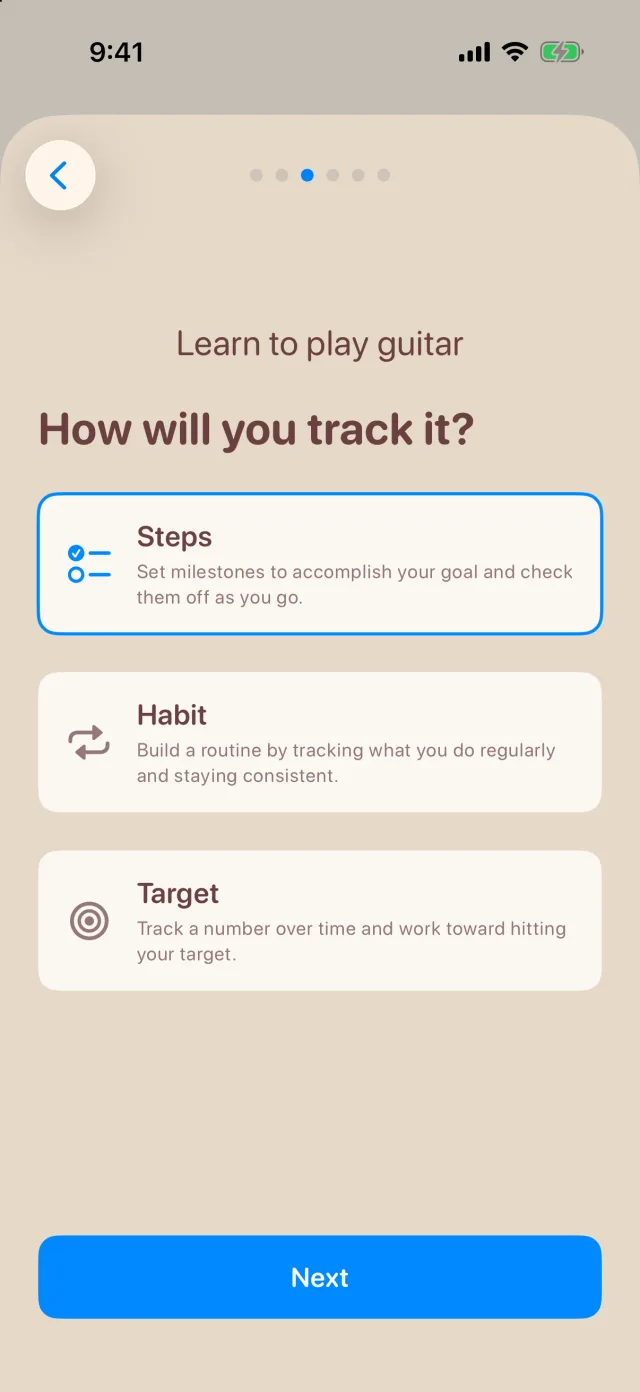
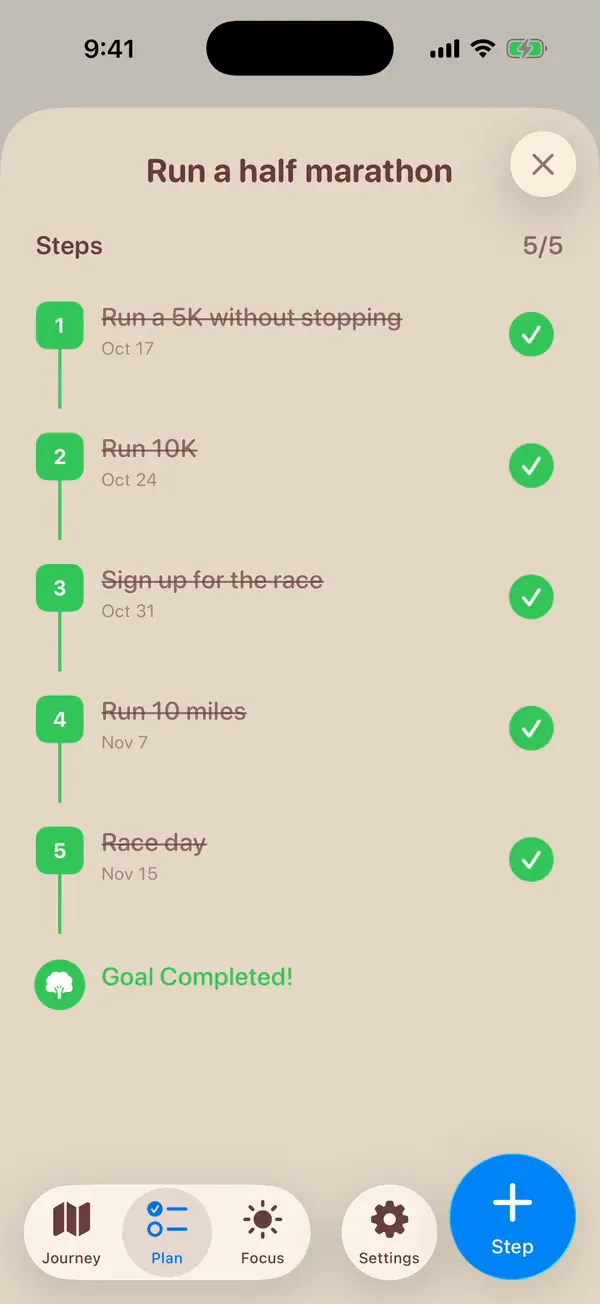
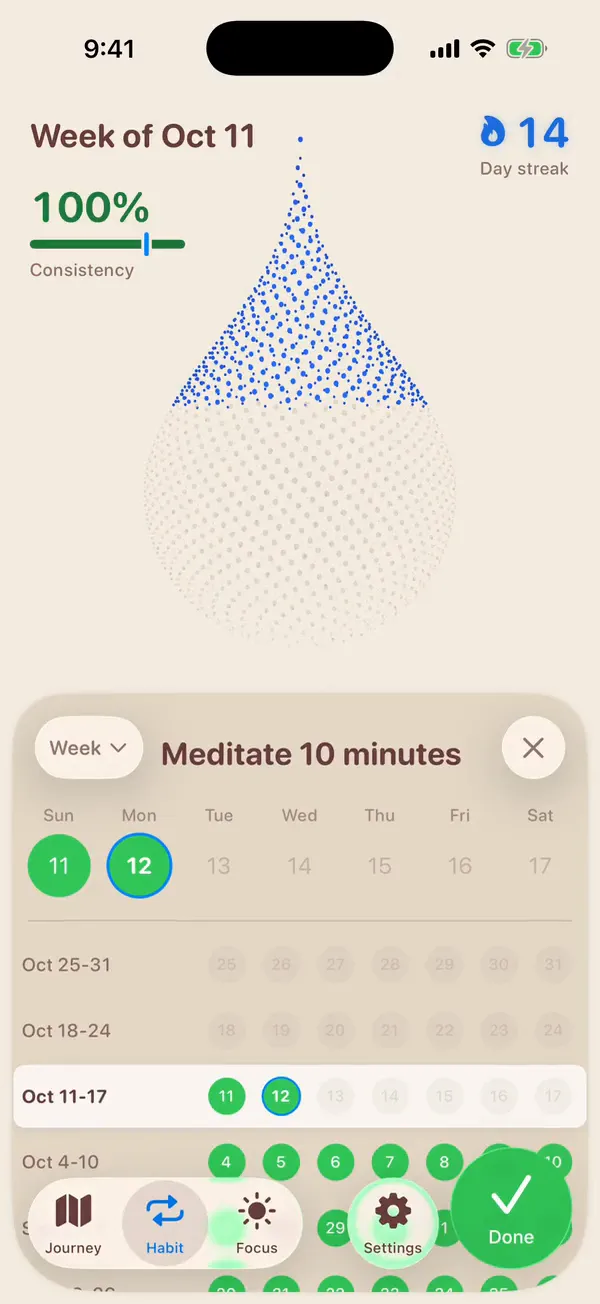
Most yearly goals end up as a mix: a goal with steps, and one or two habits underneath it that do the daily work.
Apps that do both
If you want goals and habits in one place, these are the ones I'd look at. Prices and limits are from each app's own site or App Store listing, checked October 24, 2026.
- Resolutely tracks goals as steps, habits or number targets, with guided reflection through the year. Free, every feature, with optional tips. iPhone only, with no account: your goals stay on your phone and in your own iCloud.
- Strides has tracked goals and habits since long before most of these apps existed, and added tasks in October 2026. Free for your top three goals and habits; Strides Plus is $4.99 a month or $39.99 a year in the US App Store. Runs on Apple's platforms and, since 2026, Android.
- Griply organizes goals, habits, tasks and projects together, on iPhone, Android, the web and desktop. Free for 2 goals and 2 habits; subgoals, the goal timeline and habit targets need Premium ($5.99 a month or $49.99 a year). It needs an account.
For a wider comparison, including TickTick, Habitica and Notion, see Best goal setting apps.
Frequently asked questions
What is the difference between a goal and a habit?
A goal is something you finish, like running a half marathon or saving $5,000. A habit is something you repeat with no end date, like running three times a week or putting aside $100 every payday. The habit is usually how you reach the goal.
Is a goal tracker the same as a habit tracker?
No. A habit tracker records whether you did something today and shows a streak or a consistency score. A goal tracker holds a plan toward a finish line: steps with dates, a target number, and progress toward done. Some apps, including Resolutely, Strides and Griply, do both.
What is the best app for tracking habits and goals together?
It depends on what you need. Resolutely is free with every feature and tracks goals as steps, habits or number targets, on iPhone. Strides works on Apple's platforms and Android, free for three goals and habits. Griply runs almost everywhere but needs an account, and its free plan covers 2 goals and 2 habits. More in Best goal setting apps.
How long does it take to build a habit?
Longer than the "21 days" you often hear. In a 2010 study by Lally and colleagues, people repeating a new daily behaviour took 66 days on average to reach the point where it felt automatic, with a range from 18 days to a predicted 254. Missing a single day had little effect.
Should I use a habit tracker or a goal tracker for New Year's resolutions?
Usually a goal tracker, because most resolutions have a finish line: run a race, pay off a card, learn something. Put the habits that get you there underneath each goal. There are more ideas in New Year's resolutions.
Do habit streaks actually work?
For some people, yes: a growing streak is motivating. The risk is the reset. One missed day sends it back to zero, and that's often when people quit. Tracking consistency over a few weeks gives you the same nudge without punishing a single bad day.